The Plot / Hair removal guides
How to Get Rid of Ingrown Hairs and Reduce Repeat Bumps
A practical guide to caring for ingrown hairs, changing your hair-removal routine, and knowing when a bump needs medical attention.
To help an ingrown hair settle, pause hair removal on the affected area, use a clean, warm compress and resist picking or squeezing.
The urge to squeeze can be hard to ignore. But caring for a sore bump starts with giving it a break. Once your skin has settled, small changes to your hair-removal routine may help reduce repeat bumps. Here is what to do, what to avoid, and when to get help.
What an ingrown hair actually is
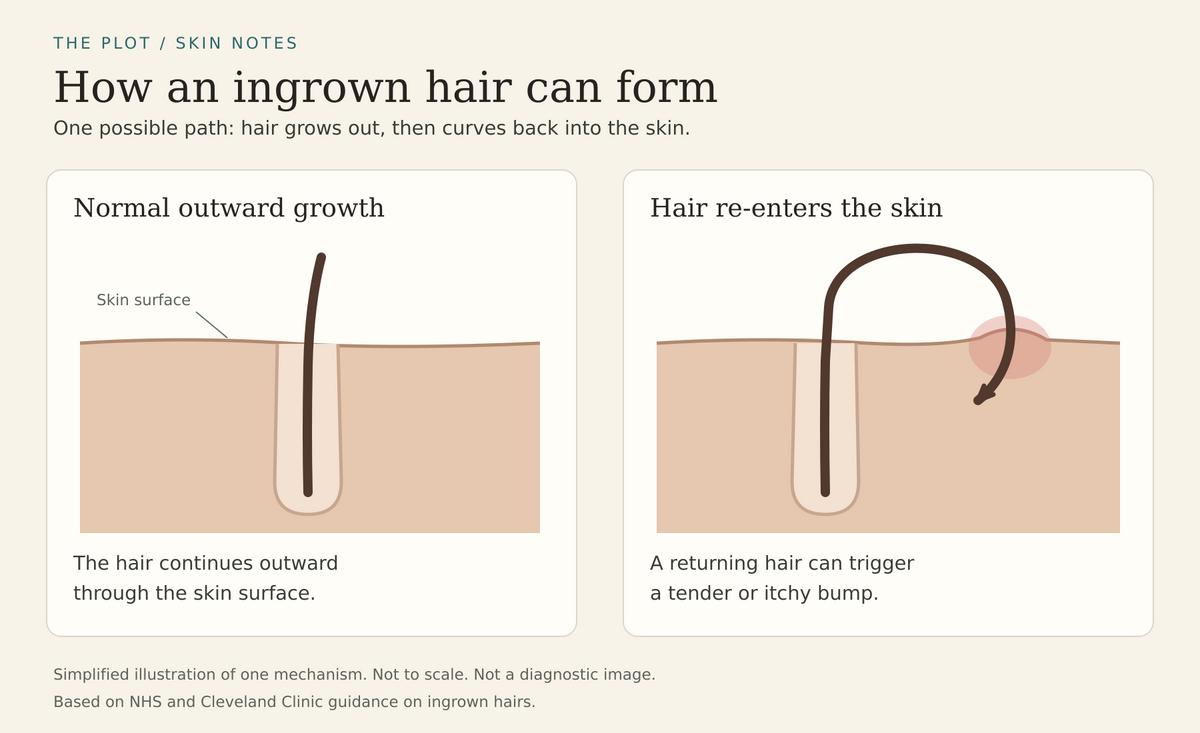
An ingrown hair grows back into the skin rather than continuing outward. It can leave an itchy or tender bump, sometimes with a hair visible beneath the surface. Coarse or curly hair is more prone to this, and shaving, waxing and tweezing can all be involved. Cleveland Clinic explains the causes and symptoms here.
A bump after hair removal is not automatically an ingrown hair. If you mainly notice widespread dark dots rather than an individual tender bump, our guide to strawberry legs after shaving explains other possibilities.
What to do about an ingrown hair now
Give the affected area a break
Stop shaving, waxing or plucking over the bump while it is irritated. A depilatory cream should not be used on irritated or broken skin either.
Use a warm compress
Hold a clean cloth dampened with comfortably warm water against the area. Cleveland Clinic suggests warm compresses for 10 to 15 minutes to help a trapped hair release. Keep the water warm rather than hot, and avoid rubbing.
Keep your hands and tools away
Do not squeeze the bump or dig into the skin with a needle or tweezers. The NHS warns that picking and squeezing can damage skin and lead to infection. If a hair needs to be removed medically, let a clinician assess it.
How to reduce ingrown hairs after shaving
Once the irritation has settled, pay attention to how close you shave and the direction your hair grows. The American Academy of Dermatology recommends softening the hair before shaving and shaving with the grain.
- Soften the hair with warm water and use a moisturizing shaving cream.
- Use a sharp, clean razor and light pressure. Repeated passes for an extra-close finish can add irritation.
- Shave in the direction of growth and rinse the blade between strokes.
- Avoid pulling the skin tight while shaving. The AAD includes this in its guidance for recurring razor bumps.
If bumps keep returning, ask a dermatologist about a routine suited to your hair and skin. There is no single shaving schedule that works for everyone. An electric trimmer that leaves some length may be worth discussing if a very close shave keeps causing trouble.

Where exfoliation fits
Gentle exfoliation removes dead skin cells and may help release trapped hairs. Avoid harsh scrubbing, especially on a sore or irritated bump. A pharmacist can help you choose a suitable product; follow its directions rather than assuming every exfoliant belongs in a daily routine.
If you use hair-removal cream, check its restrictions on exfoliation and other skin treatments before and after use. Adding several potentially irritating products at once can make it harder to tell what your skin tolerates.
Can hair removal cream help with ingrown hairs?
A depilatory cream removes hair without a razor blade. It weakens the hair's structure so the hair can be wiped or rinsed away. The NHS lists hair-removal cream as one alternative to consider when shaving contributes to ingrowns.
That does not make cream a treatment for an existing inflamed bump or a guarantee against future ingrowns. Depilatories can irritate skin and cause chemical burns, particularly when used incorrectly. Cleveland Clinic's guide to depilatory creams stresses choosing the right product for the area, patch testing and following the package directions. If you have very reactive skin or a skin condition, ask a dermatologist whether a depilatory is appropriate. A sensitive-skin label does not guarantee suitability.
For a fuller comparison of the methods, read hair removal cream vs. shaving. If you are considering waxing instead, our cream vs. waxing guide covers the different trade-offs.
Where Plot Twist fits
At Plot Twist, our body hair-removal cream comes with a reusable silicone Pebble for removing the cream and hair. It is an option to consider if you want to change how you remove body hair.
Before using it on suitable, intact skin, read the full package directions, patch test 24 hours before each use and follow the stated timer and area restrictions. Do not apply it to irritated or broken skin. Check our product FAQs alongside the directions on your tube.
When a bump needs medical attention
Seek medical advice if the area becomes very painful, hot or swollen, or if you develop a fever, chills or feel unwell. Pus, worsening symptoms or a bump that keeps returning also deserve attention. Do not assume every lump near a hair follicle is an ingrown hair.
Recurring bumps, scarring or persistent dark marks are good reasons to speak with a dermatologist. Bringing details of your hair-removal routine can help them work out what needs to change.
Frequently asked questions
Do ingrown hairs go away on their own?
Many do as the hair releases and the irritation settles. Timing varies. If symptoms worsen or fail to improve, seek advice rather than waiting for a fixed deadline.
Should you pop an ingrown hair?
No. Leave it alone and avoid digging for the hair. Picking can damage the skin and increase the risk of infection or scarring.
Can waxing cause ingrown hairs?
Yes. Removing hair from the root does not guarantee that regrowth will emerge normally. If waxing repeatedly leaves bumps, discuss other options with a dermatologist.
Can you use hair removal cream over ingrown hairs?
Do not apply it to skin that is inflamed, irritated, infected or broken. Let the area recover and follow the product's precautions before considering it for future hair removal.
Why do ingrown hairs keep appearing on the bikini line?
The pubic area commonly has coarse or curly hair, which is more likely to become ingrown. Close hair removal can contribute. Repeated or deep painful lumps should be checked rather than automatically treated as routine ingrowns.
By Ben Tabai, founder of Plot Twist. Prepared with AI assistance using the sources below. This article provides general information, not personalized medical advice. Plot Twist sells a product mentioned in this guide.